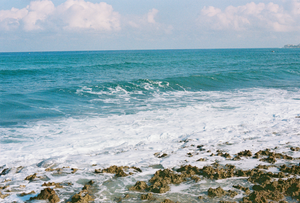
Marianao Beaches, our inspiration
The Marianao Beaches: The Lost Havana Coastline That Inspired Ntc.estudio
Before the revolution, before the seawall crowds drifted west from Vedado, and before the clubs went dark, there was a stretch of Havana coastline that defined what the city thought of itself: the Marianao beaches. A short ride west of central Havana, this was where the capital came to swim, sail, dance, and be seen — a chain of private clubs, balnearios, and sandy public strips running from Playa Marianao out toward the Reparto Náutico. It is also, specifically and intentionally, the place from which the Miami-based architecture firm Ntc.estudio takes its name and its creative DNA. On the studio's own homepage, the founders describe Marianao and the Reparto Náutico as "the neighborhood where the founders were born, and the place from which the studio takes its name" — "the origin of everything we do."
Marianao sits on the northwestern edge of Havana, facing the Straits of Florida. In the first half of the twentieth century, its beaches became the preferred playground of Havana's middle and upper classes — close enough to the city to be reached by tram or car, far enough to feel like escape. The stretch of sand and reef from Playa Marianao through La Concha to the Club Náutico waterfront was lined with balnearios (bath houses), private social clubs, and seafront restaurants that together formed a kind of open-air Cuban riviera.
The architecture was the point. These were not casual beach shacks. They were commissioned buildings by some of Cuba's most important modernist architects, designed for a climate and a social life that demanded shade, ocean breeze, and spectacle all at once. Three landmarks in particular defined the stretch.
Club Náutico de Marianao
The Club Náutico was the jewel. Originally built in the 1920s and expanded through the 1930s, the club reached its architectural apex in 1953 when Max Borges Recio — the same architect behind the Tropicana's famous Arcos de Cristal — designed a set of thin concrete vaults that rose over the beach like waves frozen mid-break. The vaults were structurally daring, visually weightless, and unmistakably Cuban: a modernist language shaped by the light, the sea, and the climate of the island rather than imported whole from Europe or the United States.
After 1960 the club was nationalized and converted into a workers' social circle, and decades of deferred maintenance took a heavy toll. In 2018 the Cuban Ministry of Tourism announced plans to restore the site as a tourist destination, though progress has been slow. What remains — in photographs, in memory, and in the eyes of architects who grew up nearby — is one of the most inventive pieces of tropical modernism ever built in the Americas.
Casino Español and the Havana Yacht Club
Just along the same coastline sat the Casino Español and, further along, the Havana Yacht Club — institutions that anchored the social life of pre-revolutionary Havana. The Yacht Club in particular, with its ballroom wing and deepwater dock, was the kind of place where Havana's leisure class spent Sundays: tennis in the morning, lunch on the terrace, dancing after dark. The Casino Español added a layer of Iberian architectural character, its pavilions and terraces stepping down toward the water.
Together with Club Náutico, they formed a coherent waterfront: not a single building, but a sequence of architectural moments strung along the sand, each visible from the next, each participating in the same conversation about how a tropical city should meet its sea.
Reparto Náutico
Behind the beach clubs sat the Reparto Náutico — a residential development of mid-century houses laid out on a quiet grid just inland from the water. This was where many of the families who used the clubs actually lived: professionals, merchants, architects, doctors. The housing stock mixed eclectic villas from earlier decades with clean modernist homes built in the 1940s and 1950s, many designed by the same generation of Cuban architects who shaped the clubs themselves. It was an everyday neighborhood rather than a showcase, and precisely for that reason it became a formative landscape for the children who grew up there.
Ntc.estudio's founders were among those children. The studio's archive — a collection of restored and colorized photographs of the old coastline that lives on their website — is part family album, part design manifesto. The images show aerial views of the Rotonda de Quinta Avenida from 1957, the Club Náutico's vaulted porticos from the water, the La Concha bathing complex, the Casino Español in its prime, and quiet residential streets of the Reparto. Taken together, they document a specific architectural sensibility: open to the sea, shaped by shade and breeze, confident about the relationship between building and climate.
Why a Miami studio named itself after a vanished coastline
Naming an architecture studio after a place that has largely disappeared — or survives only in deteriorated form on the ground — is a deliberate act. It roots a contemporary practice in a specific tradition rather than a generic set of references. For Ntc.estudio, the Marianao coastline carries three lessons that show up, implicitly or explicitly, in how the studio talks about its work.
The first is that tropical architecture is its own discipline. The Marianao clubs were not imported modernism dropped onto a warm island. They were designed by architects who understood that a building on a Cuban beach needs deep shade, cross-ventilation, and a roof that can do structural and expressive work at the same time. Max Borges Recio's vaults at Club Náutico are the clearest example: they span the space without columns, keep the interior cool, and double as the club's visual signature. Tropical modernism at its best treats climate as an opportunity rather than a constraint.
The second is that architecture and social life are inseparable. The Marianao beaches worked because the buildings made something happen — a dance floor, a terrace, a sightline to the water. The design intent was never purely formal. For a contemporary studio working in Miami, a city with its own riviera tradition and its own Cuban diaspora, that lesson translates directly into how residential, hospitality, and civic projects are conceived.
The third is memory as design material. The Ntc.estudio archive is not nostalgia. It is a working reference — a way of saying that the best parts of this tradition were never fully built out, never given their natural century of evolution, and that a studio operating in Miami today is in a position to pick up threads that were cut in 1960. Restoring and colorizing the archival photographs is itself an architectural gesture: it brings the buildings back into the present tense, where they can be drawn on.
What is left to see
For visitors to Havana who want to trace this history on the ground, the Marianao beaches today are a mixed experience. The Club Náutico's vaults still stand, though the surrounding complex is partly collapsed or closed. The Casino Español has been heavily damaged. Stretches of La Concha and Playa Marianao still function as public beaches used by neighborhood residents, though the infrastructure bears little resemblance to its mid-century form. The Reparto Náutico remains a residential neighborhood, with a surprising number of the original houses intact if weathered.
The best way to see what the coastline was is through photographs — and this is exactly what Ntc.estudio's archive provides. The images, many drawn from family collections and historical sources and restored with modern tools, give a clearer sense of the coherent architectural world that existed here than any walking tour of the ruins can manage.
A small coastline with a long reach
The Marianao beaches occupy a modest stretch of Havana's waterfront, but their cultural and architectural reach has been disproportionate. They produced buildings that rank among the most original works of Caribbean modernism, shaped the social imagination of an entire Cuban generation, and — through that generation's children — continue to inform design work being done in Miami and beyond today.
For Ntc.estudio, naming the firm after this place is a commitment. It says that the studio's work is not unmoored contemporary practice but a continuation of a specific lineage: tropical, modern, social, and deeply attached to the meeting of beauty and truth. Every project the studio produces is, in some sense, another drawing added to that archive — a continuation of a conversation that began on a beach in Marianao nearly a century ago and was never meant to end.